
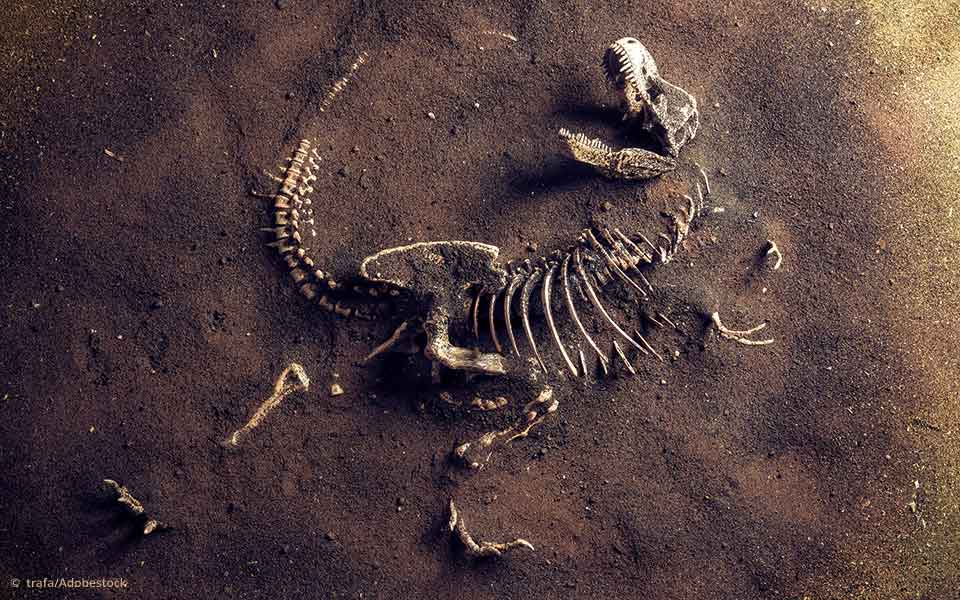
Fossilization is rare, as normally when an organism dies, its organic material gets completely decomposed, leaving only the hard skeleton behind. Fossils are formed under exceptional circumstances, which are still not well understood, in which organic material or “soft tissue” is preserved due to quick burial and isolation shortly after death. After millions of years, fossils are excavated by paleontologists, studying their morphological and microscopic features to gain valuable biological and evolutionary insights. In dinosaurs, soft tissue preservation has been reported since the 1960s, and mostly the bones have been studied.
How to detect organic compounds in fossils
Remarkably, bone histology is preserved in dinosaur fossils, even those aged more than 200 million years, and microstructures such as osteocytes and blood vessels were detected. The microstructures often resemble those of the fossil’s living relatives. To confirm this, analytical chemists use advanced sensitive instruments to detect organic compounds in fossils, part of an evolving field known as molecular paleontology. Typically, destructive techniques, like mass spectrometry, which destroy the sample, and non-destructive techniques, like Raman spectroscopy, after which the sample is recovered, are employed. One important factor to remember is that some molecules are more robust than others by nature. Among the molecules with high preservation potential are fats, but it is unlikely to find DNA, so Jurassic Park fans will be disappointed to know that cloning dinosaur DNA isn’t possible. Since the 1990s, several dinosaur specimens have been reported to contain preserved organic compounds in their bones, mainly proteins and pigments. Trabecular bone extracts of the 66 million-year-old Tyrannosaurus rex has been found to contain traces of heme, the blood pigment, while peptides of collagen have been detected in the bones of T. rex and an 80-million-year old Brachylophosaurus canadensis.
Revealing Secrets and facing Challenges
This exciting field continues to reveal new secrets, but there are challenges, especially in ruling out contamination to confirm that the organic compound indeed belongs to the fossil. One thing’s for sure: Your next visit to a natural history museum will not be the same again due to your altered perception of how these impressive fossils were formed!
Mehr erfahren:
Wie übernimmt die Chemieindustrie Verantwortung für Umwelt und Gesellschaft?
Die chemisch-pharmazeutische Industrie leistet einen wichtigen Beitrag zur Energiewende und zum Klimaschutz. Neue Produkte, innovative Verfahren und Geschäftsmodelle ermöglichen es, den Energieverbrauch zu senken und den Ausstoß von Treibhausgasen zu reduzieren....

Welche Ideen haben KI möglich gemacht?
Bereits Ende der 1940er Jahre dachte Donald Hebb über die Lernfähigkeit eines Netzes aus simulierten Neuronen nach. Später wurde dann, basierend auf diesem Gedanken und mit Hilfe eines mathematisch recht einfachen Ansatzes, das „machine learning“ entwickelt. Dabei...

Bedeuten Quantencomputer und Kryptographie das Aus für sichere Kommunikation?
Quantencomputer und Kryptographie: Das klingt nach Science-Fiction und Verschwörungsthrillern à la Dan Brown. Tatsächlich werden Quantencomputer und die auf ihnen laufenden Algorithmen in naher Zukunft ganz realen Einfluss auf die Art und Weise haben, in der wir...

Choosing the Right Journal for Your Research – Infographic and Free Webinar
Do you want to increase your chances of being published? Choosing the right journal for your paper is an important step in your publishing journey. Publishing in the right journal can help disseminate your research and support your career, and vice versa. Which...